 Get the course · $37
Train in small, calm steps at your dog's pace, and cover the workday so the long absences don't undo your progress. A self-paced course for owners who work, with a 7-day money-back guarantee.

Secure checkout by Hotmart · no hidden fees
You grab your keys and your dog is already pacing. You close the door and the crying starts. By the time you reach the car, you're checking the camera.
Maybe you've come home to a chewed door frame, a torn-up couch, or a crate you have to scrub. Maybe a neighbor has knocked. Or worse, you got a note from the landlord.
And then there's the part nobody sees. The guilt on the drive to work. The meetings you sit through thinking about your dog. You and your partner can't go out together anymore. Dinner invitations get a "maybe next time." Little by little, your home starts to feel less like a home and more like a place you're not allowed to leave.
It's lonely, too. Friends and family don't really get it, and it's a little embarrassing to explain that your dog is the reason you can't come.
Owners in dog-help groups describe it in words like these:
"I can't go to work without her crying my whole shift."
"We've tried everything: music, the TV, calming treats, a camera. Nothing helps."
"I love him, but I'm at my wits' end. I don't want to fail him."
"I feel like a prisoner in my own house."
"Our neighbor has started keeping a log of every time he barks."
"Everyone says never leave them alone. With my job, that just isn't possible."
"We got to two hours once. Then one bad day and we were back to five minutes."
Paraphrased from public posts by dog owners. Not customers, and not testimonials.
None of this means you're a bad owner, or that you have a bad dog. Separation-related distress is common, especially in rescues, dogs adopted during big life changes, and dogs whose routine suddenly shifted. It's a real fear response, not spite and not a lack of discipline.
Most owners try the same handful of things, usually all at once. Here's why each one tends to fall short on its own:
Exercise is great for dogs. But a tired dog who panics when alone is still a dog who panics when alone, just a tired one.
These can be nice extras for some dogs. They don't teach your dog that being alone is safe, so the fear stays.
A panicking dog doesn't get used to panic. Repeated distress often makes the fear stronger and the next departure harder.
For a dog in distress, confinement can turn into panic: drooling, chewing the bars, even vomiting, and broken teeth or nails from trying to escape. Some dogs love their crate. Many anxious dogs don't.
Correcting a scared dog adds more fear. It can quiet the barking and leave the anxiety underneath, or make it worse.
Good professionals can make a real difference. But a plan that only works if you're home all day leaves a working owner with a smaller bank balance and the same Monday morning problem.
Good advice, impossible schedule. If you work 9 to 5, a plan that ignores your workday breaks down on Monday morning. And staying consistent gets hard the minute work gets busy.
That last one is the big one. The research-backed approach works by building alone-time in small, calm steps, and it falls apart every time the dog gets left for eight hours in between. Most programs mention this rule. Very few show a working owner how to actually follow it.
You find out how long your dog can stay relaxed alone today, even if that's 10 seconds, and start just below it. Each calm session gets a little longer. Your departure cues (keys, shoes, the door) get boring along the way. The Absence Diary tells you the next step, so you never have to guess.
While your dog is learning, they shouldn't be left alone past what they can handle. The Work-Week Coverage System helps you plan each workday with daycare, a walker, a neighbor, a friend or a work-from-home day, with $0, ~$75 and ~$200-a-week options.
Together, these mean you keep your job, your dog stops rehearsing panic, and progress actually sticks. Sessions are short enough for a weeknight. On the busy weeks, when work gets in the way, coverage holds the line until you can get back to sessions.
The method is based on published research and veterinary behavior guidance on separation-related problems: gradual desensitization, managing absences, and reading stress signals. The course cites its sources.
The goal of week one isn't a cured dog. It's to stop things getting worse, know your real starting point, and calm things down with the neighbors. About 15 to 35 minutes a day.
| Day | What you do |
|---|---|
| 1 | Watch Start Here, check the vet red flags, and film one "normal" departure to see what really happens. |
| 2 | Map your work week in the Coverage Planner and line up the next 5 workdays. |
| 3 | Set up a calm zone, switch to low-key goodbyes and hellos, and try timed food toys. |
| 4 | List your departure cues and make keys and shoes boring. |
| 5 | Find your starting point with the Threshold Calculator, then do your first calm, short absence. |
| 6 | Send the neighbor note, give caregivers the handoff card, and do session two. |
| 7 | Review the Diary graph and adjust next week's coverage. |
About 2.5 hours in total: short videos with an AI narrator and quick text lessons. Watch on your phone at lunch, then do the step that evening.
How the plan works, the one rule (never past your dog's limit), and when to see your vet before you start.
Anxiety, boredom or frustration? Does your dog need you, or just anyone? Film a baseline and spot the red flags. Plus "why my dog?" (and why it's not your fault).
Why crying it out backfires, how to set up a calm zone, boring departures and returns, where exercise and food toys help (and where they don't), and why punishing messes makes things worse.
Your coverage menu, building your week in 15 minutes, three budget plans, the caregiver handoff, what to do when coverage falls through, and shrinking coverage as your dog improves.
Reading stress signals, the threshold test, setting up a camera, and an optional "calm on the mat" plan for dogs who can't relax even when you're home.
Your personal cue list, making keys, shoes and bags boring, and working through the door itself.
What a real session looks like, simple step-up rules, using the Diary, rest days, real-world departures, and the "empty bowl" test for food toys.
Why progress isn't a straight line, getting unstuck, big changes (moving, a new job, back to the office), night-time problems, and when to bring in a professional.
From four hours to a covered workday, keeping it going, and what to do if it comes back.
We don't have customer reviews to show you yet, and we won't make any up. Here's what you can verify instead: the guidance behind the method, and the actual tools you'll use.
These organizations and authors are not affiliated with Alone & Okay and do not endorse it. Our own rules of thumb (like the 0–3 stress score) are labeled as such inside the course.
Included with the course. They work on your phone, save on your device, and need no app or account.
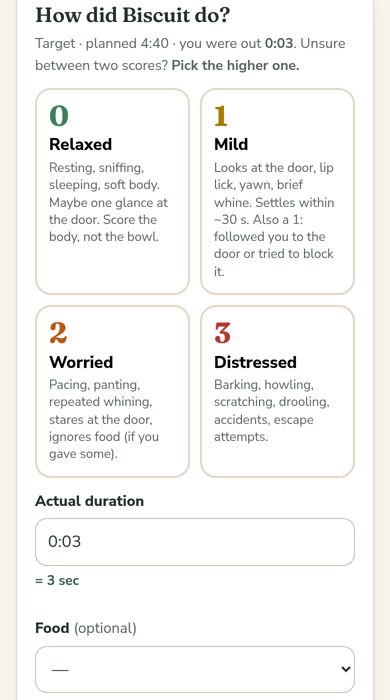
Time each session, score your dog 0–3, and get the next target suggested by the plan's rules. Includes a graph and milestones.
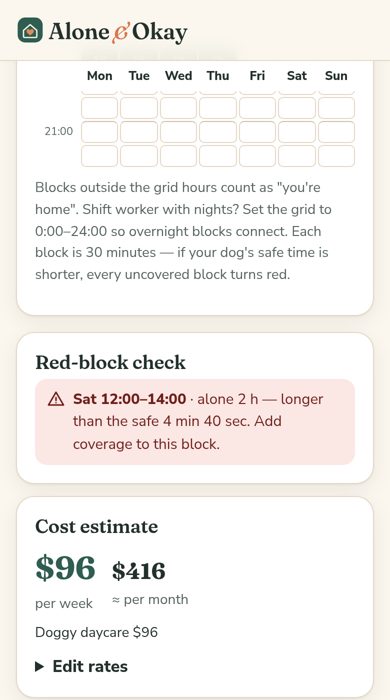
Plan Monday to Sunday in 30-minute blocks. It flags in red any time your dog would be alone too long, and shows the weekly cost.
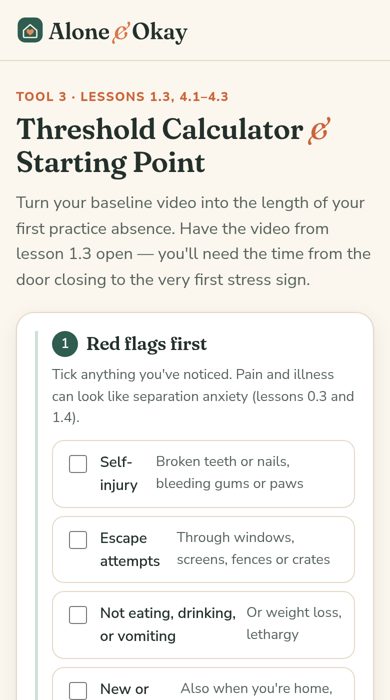
Turns your baseline video into a safe starting duration, and tells you when it's time to see a professional first.
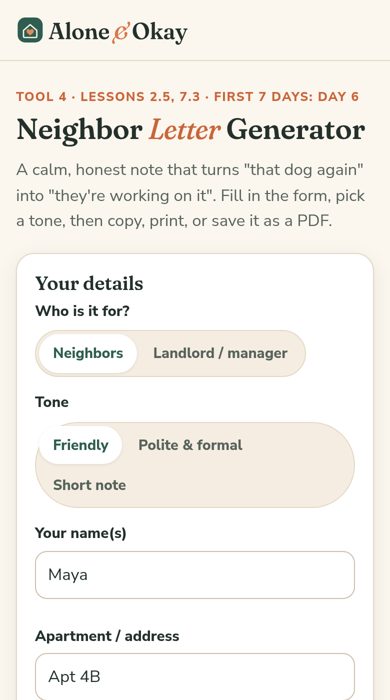
A friendly, filled-in note for neighbors or your landlord in two minutes.
Honestly, it depends on your dog. As a rough planning guide, dogs who start at a minute or more often reach 10 calm minutes in about 2 to 7 weeks of sessions and an hour in about 1.5 to 3 months. Dogs who start in seconds usually take longer. Published studies show treatment taking weeks to months. These are our estimates, not promises. The Diary shows your dog's real progress.
Almost everyone has a week where it feels like you're back at the beginning. A bad day, a change in routine or a missed coverage day can knock the calm time down. Module 7 shows you why that happens and how to step back and climb again without starting from zero. The Diary keeps the record, so you can see how far you've really come.
Typical US prices from Rover, Angi and VetCostGuide (2026); yours may differ. Good trainers and daycare can be worth it, and the course helps you use them only where they matter most.
Tried before and it didn't work? That's common. Most plans skip covering the workday, so a long absence undoes the progress. Here you train in small steps and plan coverage, with rules for bad days.
For severe cases, talk to your veterinarian or a certified behavior professional. The course doesn't give medication advice. Every dog is different and results vary.
🔒 Secure checkout by Hotmart · no hidden fees.
Look through the lessons, try the tools, and do the first week. If it's not for you, ask for a refund within 7 days through Hotmart and you get every cent back. No questions asked.
It's worth it if you want a structured, step-by-step plan built around a workday, for $37 one time, with a 7-day money-back guarantee through Hotmart. It is not a cure, results vary from dog to dog, and it doesn't replace your vet or a behavior professional for severe cases.
The first plan takes 7 days of short daily sessions. Real change with separation problems usually takes weeks to months and varies a lot from dog to dog, so we don't promise a timeline. The Diary tool shows your own dog's progress.
Owners of dogs of any age who struggle when left alone, especially people who work long days and need a plan to cover the workday while they train. If your dog injures themselves, stops eating or the behavior started suddenly, see your vet first.
No honest course can promise that. Alone & Okay gives you a clear, research-based plan and tools to follow it. Many dogs improve a lot with consistent practice, but every dog is different, and some need help from a vet or a certified behavior professional alongside training.
That's exactly who it's built for. Sessions are short (often under 20 minutes), and Module 3 shows you how to cover workdays on different budgets, including $0 options like swapping favors or using a lunch break.
Lesson 1.2 covers this. Some dogs need a specific person, others just need anyone. The answer changes how you set up coverage.
It may not replace them, and it doesn't need to. What Alone & Okay adds is the workday piece: a coverage plan for the hours you're at work, and tools that make daily sessions easy to keep up. You can use it alongside a professional.
Yes. Progress with separation problems is rarely a straight line. The plan has clear rules for stepping back after a bad day and building up again, so a setback doesn't mean starting over.
It helps a lot, because you need to see how your dog actually reacts. A basic Wi-Fi camera or an old phone running a video call is enough. Lesson 4.3 walks you through the setup.
Yes. You'll learn how to tell whether your dog is calmer in a crate or a gated calm zone, and why forcing a crate on a panicking dog can backfire.
The course doesn't recommend any. Medication can help some dogs, and that decision belongs with your vet. The course tells you when to talk to them and works alongside whatever your vet advises.
It's for dogs of any age who struggle when left alone. Many young puppies cry when separated as a normal phase, and the course helps you tell the difference.
Right after checkout, Hotmart emails you a login. The lessons are in your Hotmart members area, and the tools open in your phone's browser.
Alone & Okay is an independent program built from published research and veterinary behavior guidance, with sources listed in the course. We're not veterinarians, and the course doesn't replace your vet or a certified behavior consultant.
Start with one short session and one planned workday. Then let the plan take it from there.
Secure checkout by Hotmart · no hidden fees
P.S. The single most useful thing you can do this week is stop leaving your dog alone past what they can handle. Day 2 of the plan shows you how, even on a workday. You can start tonight.